
In a competitive market, relying on generic software is no longer a viable strategy for companies aiming to lead their industry. The shift toward bespoke technology is accelerating, with the global custom software market projected to exceed $180 billion by 2031. Understanding the specific custom web app benefits, such as complete intellectual property ownership and seamless workflow integration, is essential for any growth-stage business looking to scale.
By building a solution tailored to your unique internal processes, you eliminate the friction caused by rigid, off-the-shelf platforms. Custom applications provide a distinct competitive advantage by offering branded user experiences and features that cannot be replicated by standard tools. This strategic investment ensures your technology evolves alongside your business requirements rather than acting as a bottleneck to innovation.
Key Takeaways
- Custom software transforms technology from a recurring subscription expense into a high-value capital asset through full intellectual property ownership.
- Bespoke applications eliminate operational friction by aligning perfectly with unique business logic, avoiding the rigid constraints and ‘feature bloat’ of standard SaaS platforms.
- Tailored web apps provide a significant competitive advantage by offering proprietary features and branded user experiences that generic tools cannot replicate.
- Custom builds act as a central nervous system for growth-stage companies, seamlessly integrating legacy systems to dismantle data silos and automate workflows.
Tailored Workflows Versus Rigid SaaS Frameworks
Selecting a custom web application over a standard SaaS framework represents a strategic pivot from passive software consumption to active process optimization. Off the shelf solutions often force businesses to reshape their internal operations to fit within the rigid constraints of a pre-built interface, which can lead to significant friction and lost productivity. By contrast, a custom build is engineered from the ground up to mirror your specific business logic, ensuring that the technology serves the workflow rather than the other way around. This alignment eliminates the feature bloat common in generic platforms, where companies pay for tools they never use while lacking the specific functions they actually need. Investing in a tailored solution ensures that every click and every data field serves a purpose, directly contributing to a more efficient and streamlined operational environment.
The long term return on investment for custom software becomes increasingly evident when evaluating the scalability and agility of a growing enterprise. Rigid SaaS frameworks often hit a ceiling, requiring expensive workarounds or third party integrations that become brittle over time. A bespoke application grows alongside your company, allowing for seamless updates and new module additions that reflect your evolving market position. Because you own the intellectual property, you are no longer at the mercy of a vendor’s roadmap or sudden price hikes. This level of control provides a distinct competitive advantage, as you can deploy unique features and branded user experiences that competitors using generic tools simply cannot replicate.
Modern growth stage companies are increasingly viewing custom development as a strategic necessity rather than a luxury expense. With the market for custom software projected to reach over $181 billion by 2031, the shift reflects a broader understanding that unique internal processes are often a company’s most valuable asset. Protecting those processes within a proprietary digital ecosystem prevents the dilution of your brand’s operational secrets. Instead of struggling with restrictive interfaces, your team can focus on high value tasks supported by an interface designed specifically for their needs. Ultimately, the transition from a rigid framework to a tailored workflow is an investment in the long term independence and efficiency of your entire business infrastructure.
Long-Term ROI Through Full Intellectual Property Ownership
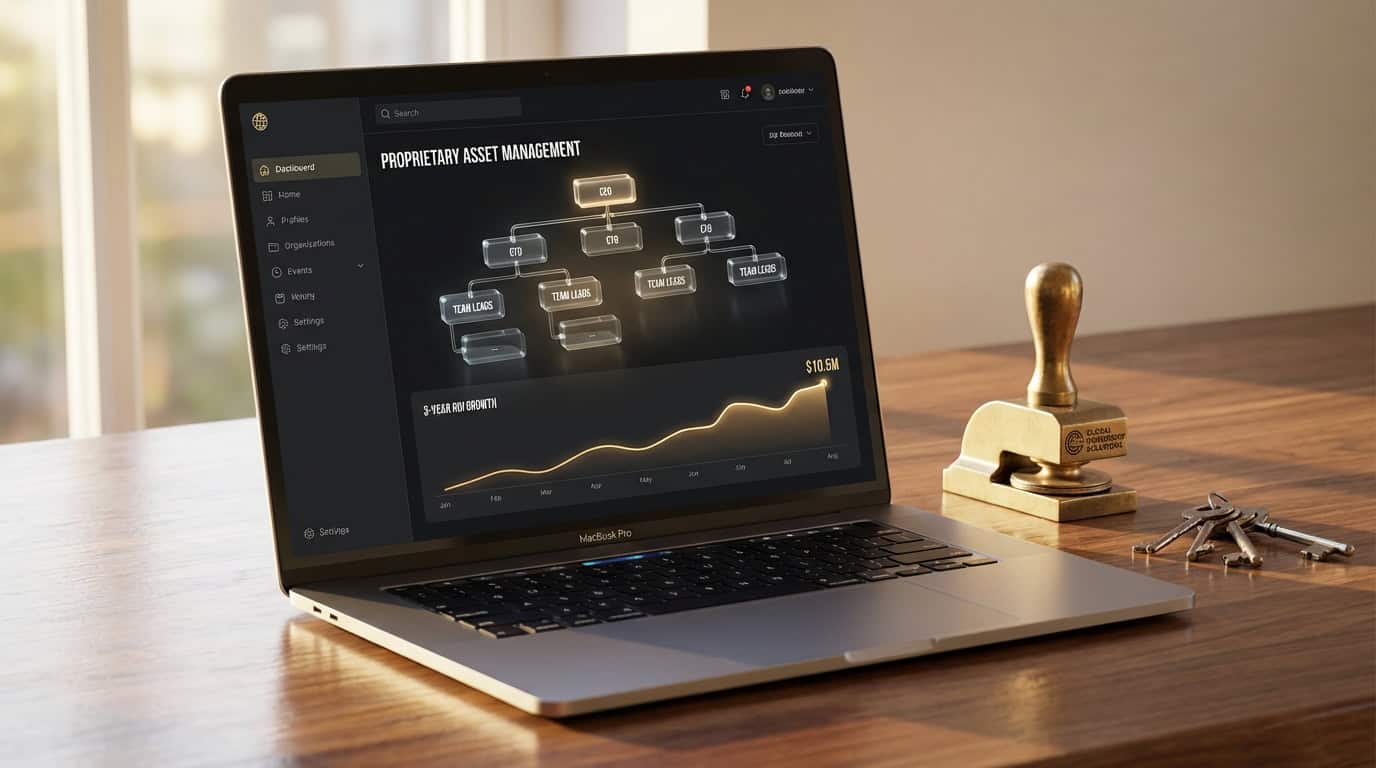
Building a custom web application represents a shift from a recurring expense to a strategic capital investment that yields significant long term returns. While off the shelf SaaS platforms often seem cost effective at first, their monthly subscription fees and per user pricing models can quickly erode profit margins as your business scales. By choosing a custom build, you eliminate these perpetual overhead costs and the risk of sudden price hikes from third party vendors. This financial independence allows you to reallocate budget toward innovation rather than simply maintaining access to your own operational tools. Ownership of the source code ensures that your software remains a permanent asset on your balance sheet rather than a temporary service.
The true value of a custom solution lies in the creation of proprietary intellectual property that directly enhances your company’s total valuation. Investors and potential buyers view unique, in house technology as a formidable moat that protects your market position and differentiates your brand from others using generic tools. Because you own the software outright, you have the total freedom to modify, expand, or even license the technology to others without seeking permission or paying royalties. This level of control prevents vendor lock in, ensuring that your business logic and data remain securely under your command. As your application evolves with your specific workflows, it becomes a specialized engine for growth that generic competitors cannot replicate.
Strategic growth requires a foundation that is not dependent on the roadmap of an external software provider. Custom web apps provide this stability by allowing you to prioritize features based on your unique ROI goals rather than waiting for a generic platform to release relevant updates. This agility enables you to respond to market shifts faster, giving you a distinct advantage where speed and efficiency are paramount. The initial investment is justified by the elimination of manual workarounds and the long term accumulation of equity in a digital product. Ultimately, full intellectual property ownership transforms your technology stack from a functional necessity into a high value business asset that drives sustainable profitability.
Seamless Data Integration With Existing Legacy Systems
One of the most significant advantages of a custom web application is its ability to bridge the gap between modern innovation and your established legacy infrastructure. While off the shelf software often forces businesses to manually export data or rely on clunky third party plugins, a custom build creates a direct communication layer through tailored API connections. This ensures that your new interface talks directly to older, mission critical databases without the risk of data duplication or manual entry errors. By eliminating these technical barriers, you protect the value of your historical data while gaining the speed of a modern web environment.
Investing in a custom solution provides a higher return by effectively dismantling the data silos that typically plague growth stage companies. Generic platforms often lack the flexibility to integrate with proprietary or aging systems, leaving valuable information trapped in isolated departments. A tailored web app acts as a central nervous system, pulling real time metrics from your legacy software and presenting them in a streamlined, actionable dashboard. This level of synchronization allows your team to make faster decisions based on a unified truth rather than fragmented reports from multiple disconnected sources. Understanding how these tools fit into a digital business strategy is essential for long-term success.
The long term ROI of custom integration is found in the removal of the hidden costs associated with inefficient workflows and vendor limitations. Rather than paying for expensive middleware or hiring staff to manage manual data transfers, a custom build automates the flow of information across your entire digital ecosystem. This seamless connectivity ensures that as your business scales, your technology stack remains a cohesive unit rather than a collection of incompatible tools. By prioritizing a build that respects your existing architecture, you create a sustainable foundation for future growth that off the shelf products simply cannot match.
Future-Proof Your Business with Custom Scalability
Ultimately, choosing a custom web application is an investment in your company’s long-term autonomy and market positioning. While off-the-shelf software may offer a lower barrier to entry, it often becomes a bottleneck as your business grows and requires more specialized workflows. By developing a tailored solution, you eliminate the constraints of generic features and avoid the recurring costs associated with per-user licensing fees. Owning your intellectual property ensures that your digital infrastructure remains a proprietary asset that can scale alongside your ambitions without vendor lock-in.
The strategic value of a custom build lies in its ability to provide a seamless user experience that competitors simply cannot replicate with template-based tools. In an environment where efficiency and differentiation are the primary drivers of ROI, having a custom designed website or software that adapts to your processes rather than forcing you to adapt to its limitations is a significant advantage. Modern growth-stage companies are increasingly recognizing that custom web app benefits are no longer a luxury but a fundamental necessity for maintaining a competitive edge. This shift toward personalized technology allows you to streamline operations while delivering a unique brand promise to your customers.
Deciding between a generic platform and a specialized build requires a mistake evaluation of your specific goals and technical requirements. If you are ready to move beyond one-size-fits-all software and want to build a high-performing digital foundation, exploring professional guidance is the best next step. Discover how professional development services can help you manage the complexities of creation and provide the strategic direction needed for a successful launch. Investing in a solution built for your unique needs ensures your business remains agile, compliant, and ready for future expansion.
Frequently Asked Questions
1. How does a custom web app improve operational efficiency compared to SaaS?
Custom web applications are engineered to mirror your specific business logic, eliminating the friction caused by rigid, off the shelf frameworks. This alignment removes unnecessary feature bloat and ensures every tool within the interface directly supports your internal workflows.
2. What are the long term financial advantages of choosing custom software?
While the initial investment is higher, you eliminate recurring per user licensing fees that scale aggressively as your company grows. You also gain complete intellectual property ownership, turning your software into a valuable business asset rather than a monthly expense.
3. Can custom web applications scale alongside my business growth?
Yes, custom solutions are designed to evolve with your requirements, ensuring your technology never becomes a bottleneck to innovation. You have the flexibility to add features and expand capacity as your market demands shift, providing a sustainable foundation for scaling.
4. How does bespoke technology provide a competitive advantage?
You gain a unique edge by offering branded user experiences and proprietary features that your competitors cannot replicate with standard tools. This allows you to define the digital standards in your industry rather than following the constraints of generic software.
5. What does it mean to have complete intellectual property ownership?
Owning the code means you have total control over the software’s roadmap and can monetize or modify the platform without third party restrictions. This ownership protects your business from sudden price hikes or service shutdowns common with external SaaS providers.
6. Will a custom web app integrate with my existing tools?
Custom builds are designed for seamless integration, allowing different parts of your tech stack to communicate effectively. This creates a unified data environment that streamlines your processes and improves overall organizational transparency. Understanding the development timeline for these integrations is key to planning your digital transformation.