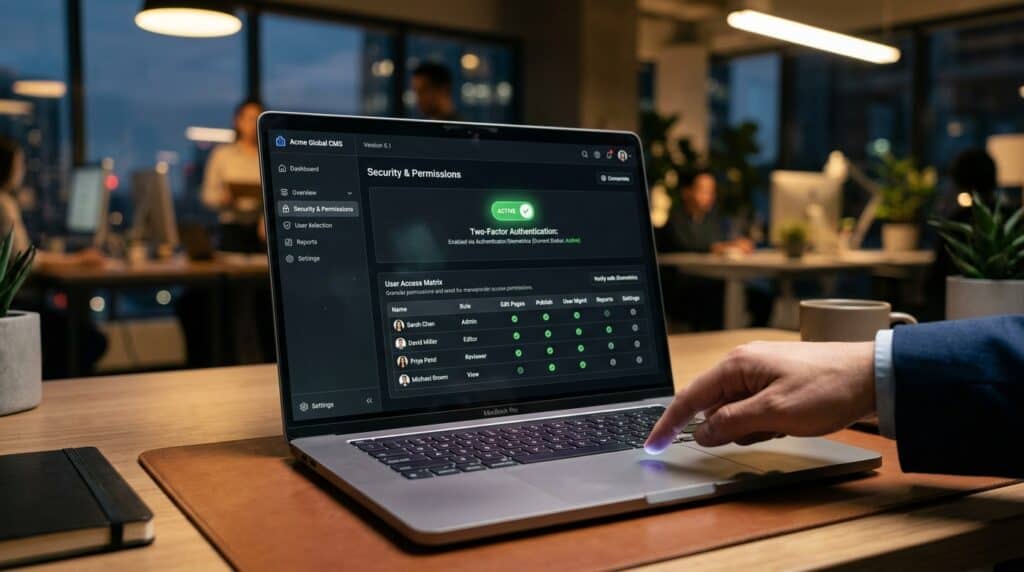
Protecting corporate digital assets has become a critical priority as automated threats evolve to bypass traditional defenses. Modern organizations are moving beyond simple perimeter security to embrace sophisticated enterprise cms security features that prioritize continuous validation and data integrity. As content becomes increasingly distributed across mobile, web, and IoT touchpoints, the focus has shifted toward a proactive, resilient architecture that treats every access request as a potential risk.
Current security requirements demand a transition to Zero-Trust principles, where identity is verified at every layer of the content lifecycle. By integrating hardware-based authentication and decoupled structures, enterprises can effectively neutralize common attack vectors while maintaining high-speed delivery. Protecting a brand’s reputation now requires a security-first mindset that views protection as an ongoing operational process rather than a one-time configuration.
Key Takeaways
- Modern enterprise security requires a transition to Zero-Trust architecture, where every access request is continuously validated regardless of network location.
- Implementing hardware-based multi-factor authentication and biometric standards is essential to neutralize sophisticated credential harvesting and phishing attempts.
- Decoupled headless architectures significantly reduce the attack surface by isolating the administrative backend from the public-facing presentation layer.
- Granular role-based access controls and immutable audit trails provide the necessary visibility and restriction to prevent lateral movement and ensure data integrity.
Implementing Zero Trust And Biometric Authentication Standards
Modern enterprise CMS platforms have transitioned away from traditional perimeter-based security to a robust Zero Trust architecture that assumes no user or device is inherently safe. This model requires continuous validation for every access request, ensuring that administrative privileges are never granted based solely on network location. By implementing granular access controls and real-time session monitoring, IT directors can effectively neutralize the threat of lateral movement within the system. This proactive stance is essential for protecting sensitive corporate assets in a distributed, omnichannel environment where content often spans multiple digital touchpoints.
The integration of hardware-based multi-factor authentication and biometric standards represents the new baseline for securing administrative layers. Password-only access is no longer sufficient to combat sophisticated credential harvesting or phishing attempts. Modern platforms now leverage physical security keys and biometric push notifications to provide a secure layer of identity verification. These hardware-backed protocols ensure that only authorized personnel can modify critical infrastructure, significantly reducing the risk of unauthorized content changes or data breaches.
Beyond simple login security, these advanced authentication frameworks provide a seamless yet highly secure experience for global teams. Security officers can enforce strict compliance standards while allowing content creators to work efficiently from any location. The shift toward biometric validation also eliminates the common vulnerabilities associated with human error and weak password management. By prioritizing these hardware-centric security features, enterprises can build a resilient digital presence that stands up to evolving threats.
Reducing Attack Surfaces Via Decoupled Headless Architectures

Modern IT directors are increasingly moving away from monolithic systems in favor of decoupled headless architectures to fundamentally shrink the digital attack surface. By separating the content management backend from the public-facing presentation layer, enterprises effectively hide the administrative interface from the open internet. This structural isolation ensures that even if a frontend vulnerability is discovered, the core database and sensitive content repository remain inaccessible to external actors. In this model, the backend exists in a private environment, reachable only through secure, authenticated connections that align with zero trust principles. This separation is a critical defense strategy for corporate entities that cannot afford the reputational risk of a public platform breach.
The shift to headless architecture also provides a robust defense against common web vulnerabilities like SQL injection and cross-site scripting. Since the frontend fetches content via secure APIs rather than direct database queries, there is no direct path for malicious code to reach the server’s data layer. Security officers value this approach because it allows the development team to harden the delivery environment independently of the content creation environment. Furthermore, using static site generation or pre-rendered components at the edge further reduces the execution of server-side code during a user session. This multi-layered protection strategy ensures that the most common vectors for automated attacks are neutralized before they can impact the corporate infrastructure.
Beyond technical isolation, a decoupled framework allows for more granular control over user permissions and administrative access. Since the content backend is not hosted on the same domain as the public site, it is significantly harder for attackers to locate and target the login portal. Enterprises can implement strict hardware-based multi-factor authentication and IP whitelisting on the hidden backend without affecting the performance or accessibility of the customer-facing experience. When choosing the optimal architecture for a secure site, this choice gives security teams the flexibility to deploy aggressive defensive measures on the management side while maintaining a seamless omnichannel presence for the brand. By removing the single point of failure inherent in traditional CMS designs, organizations build a more resilient digital ecosystem.
Granular Role Based Access Controls And Audit Trails
Modern enterprise security mandates a transition from broad administrative access to a rigorous enforcement of the least-privilege principle. By implementing granular role-based access controls, IT directors can restrict content interactions down to the specific folder or asset level, ensuring users only engage with data essential to their function. This precision is vital in a decentralized environment where marketing teams, external agencies, and internal developers all converge on the same platform. A robust system architecture validates every request through a zero-trust framework, preventing lateral movement in the event of a credential compromise. These controls are not merely organizational tools but act as a primary defense mechanism against internal configuration errors and external data exfiltration.
The integrity of a corporate digital presence also relies on the deployment of immutable audit trails that capture every modification across the content lifecycle. Every action, whether performed by a human editor or an automated agent, is recorded in a tamper-proof log that provides a definitive history of system changes. Security officers utilize these logs to conduct forensic investigations, satisfy strict compliance requirements, and verify the authenticity of published information. Distinguishing between human-initiated updates and machine-driven optimizations is critical for maintaining brand governance. These logs remain permanent and unalterable, providing a transparent roadmap of who accessed what, when they accessed it, and exactly what was changed.
By integrating these specialized controls with real-time monitoring, enterprises can proactively identify anomalous behavior before it escalates into a security breach. Continuous validation of user roles ensures that permissions evolve alongside the organization, removing access immediately when it is no longer required. This proactive stance is complemented by the audit trail, which serves as a source of truth for both internal audits and external regulatory reviews. Protecting high-value corporate assets requires this dual approach of strict preventative barriers and comprehensive visibility. Ultimately, these features provide the structural resilience necessary to defend complex, omnichannel environments against sophisticated threats.
AI Driven Threat Detection And Automated Patch Management

Modern enterprise content management systems have evolved to utilize machine learning algorithms that establish a baseline of normal user behavior and system activity. These engines continuously monitor for anomalies such as unusual login locations, rapid bulk file exports, or unauthorized API calls that deviate from established patterns. By identifying these subtle deviations in real time, security officers can intercept potential insider threats or account takeovers before data exfiltration occurs. This proactive posture shifts the security burden from reactive manual monitoring to an intelligent, self-healing ecosystem designed for high-stakes corporate environments.
Automated patch management serves as a critical defense layer by eliminating the window of opportunity for hackers to exploit known vulnerabilities. In a traditional setup, the delay between a vulnerability disclosure and a manual update can leave an organization exposed for days or weeks. Modern enterprise platforms resolve this by deploying security patches automatically across distributed environments, ensuring that threats are mitigated without requiring human intervention. This seamless update process maintains the integrity of the corporate digital presence while allowing IT teams to focus on strategic initiatives rather than routine maintenance.
Integrating these advanced capabilities ensures that digital infrastructure remains resilient against the increasingly sophisticated nature of automated cyber attacks. By leveraging a system that learns and adapts, enterprises can protect sensitive intellectual property and maintain regulatory compliance across various global jurisdictions. The combination of predictive threat intelligence and rapid automated response creates a robust fortress for omnichannel content delivery. To maintain this level of protection, many organizations conduct enterprise WordPress security audits to identify hidden weaknesses. Ultimately, these features provide the peace of mind necessary for IT directors to manage complex, large-scale web architectures with confidence in their security posture.
Securing Your Enterprise with Zero-Trust Architecture
In a high-stakes environment, a robust enterprise CMS is no longer just a content repository but a critical line of defense for corporate reputation. IT directors and security officers must prioritize platforms that move beyond perimeter-based security toward a Zero-Trust architecture that validates every interaction. Failing to implement these advanced protections can result in data breaches that erode stakeholder trust and invite regulatory scrutiny. By investing in a solution that integrates threat detection and hardware-based authentication, your organization ensures that its digital presence remains resilient against increasingly sophisticated cyber threats.
Selecting an enterprise CMS requires a rigorous evaluation of how a platform handles distributed content across diverse omnichannel environments. The shift toward decoupled architectures and headless configurations significantly reduces the attack surface, making it an essential consideration for scaling enterprises. Security must be viewed as a continuous operational process rather than a one-time configuration during the deployment phase. The right platform will offer a seamless balance between high-level security protocols and the agility required to meet modern business demands.
To ensure a transition to a more secure environment is seamless and data-driven, it is vital to partner with experts who understand the complexities of modern digital transitions. Discover how our Content Migration Service Pricing Guide For Secure Data Replatforming can help move valuable assets into a protected, high-performance architecture without compromising integrity. Professional technical oversight is necessary to safeguard corporate reputation during every stage of digital evolution. Taking this proactive step ensures infrastructure is ready for future challenges.
Frequently Asked Questions
1. What exactly is Zero Trust architecture in the context of an enterprise CMS?
Zero Trust architecture is a security model that operates on the principle that no user or device is trusted by default, even if they are inside the network perimeter. You must continuously validate every access request at every layer of the content lifecycle to ensure total system integrity.
2. How does hardware-based authentication improve CMS security over traditional passwords?
Hardware-based authentication and biometric standards eliminate the vulnerabilities associated with password-only access, which can be compromised by automated threats. By requiring physical or biological verification, you create a robust barrier that effectively neutralizes common administrative attack vectors.
3. Why is a decoupled architecture considered more secure for your digital assets?
Decoupling the content management layer from the delivery layer reduces the attack surface by hiding the administrative backend from the public internet. This structure allows you to maintain high-speed content delivery while keeping your core database and sensitive assets isolated from potential front-end exploits.
4. How do granular access controls prevent lateral movement within a system?
Granular access controls ensure that users are only granted the specific permissions necessary for their roles, limiting their reach within the platform. By combining these controls with real-time session monitoring, you can stop attackers from moving between different sections of your corporate infrastructure if a single account is compromised.
5. What role does continuous validation play in protecting your brand reputation?
Continuous validation treats security as an ongoing operational process rather than a static configuration, ensuring that every interaction with your content is legitimate. This proactive stance is vital for protecting your digital assets from sophisticated breaches that could otherwise lead to costly data leaks and damage to brand credibility.
6. Can these security features handle content distribution across IoT and mobile touchpoints?
Modern enterprise security features are specifically designed for a distributed, omnichannel environment where content spans web, mobile, and IoT devices. You can maintain a resilient architecture by enforcing identity verification and data integrity standards across every endpoint in your network.