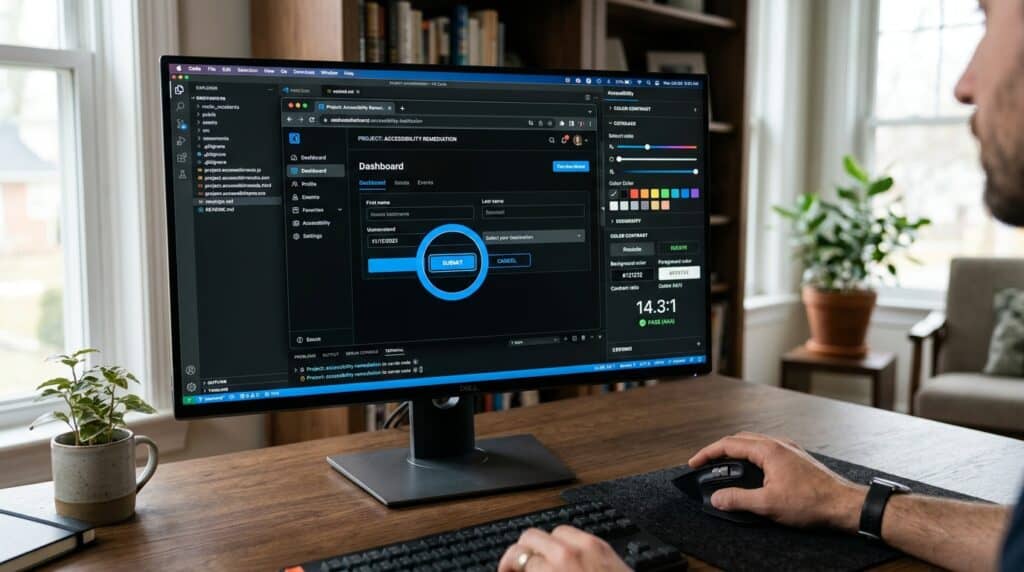
Navigating evolving digital compliance requirements has never been more urgent as WCAG 2.2 AA becomes the global benchmark. With the enforcement of the European Accessibility Act (EAA) and new DOJ Title II mandates, understanding your accessibility remediation service cost is a critical budgetary requirement. Organizations must now balance the rising demand for legal protection with the need for scalable, long term digital inclusivity.
Modern pricing models are shifting away from expensive, manual only audits toward efficient hybrid solutions that leverage AI to reduce overhead. Whether you are managing a small business site or an expansive enterprise ecosystem, the financial commitment depends on your asset’s complexity and the depth of integration required. Investing in these services today prevents the compounding expenses of legal fees and emergency fixes later.
Key Takeaways
- Compliance with WCAG 2.2 AA is now a global legal requirement driven by the European Accessibility Act and DOJ Title II mandates, making accessibility remediation a critical risk management strategy.
- Remediation costs scale with site complexity, ranging from $3,000 for small sites to over $100,000 for enterprise ecosystems, with ongoing maintenance retainers necessary to prevent compliance regressions.
- Hybrid remediation models that combine AI-driven error detection with expert manual testing reduce initial expenses by 30% to 50% while maintaining the accuracy required for legal protection.
- Delaying accessibility fixes triggers the ’10x Rule’ of technical debt, where retroactive emergency repairs and legal settlements far exceed the cost of proactive, design-phase integration.
Average Remediation Pricing By Site Complexity
The cost of accessibility remediation is primarily dictated by the total page count and the technical complexity of your digital ecosystem. For small websites with 20 to 50 pages, organizations should budget between $3,000 and $15,000 for one time fixes, following an initial audit that typically costs up to $5,000. These projects usually focus on resolving fundamental WCAG 2.2 AA violations, such as color contrast issues and basic keyboard navigation. While these assets are smaller, the investment is critical for mitigating legal risks and meeting the growing expectations of social responsibility.
Medium sized business sites and complex e-commerce platforms require a more significant financial commitment due to dynamic content and intricate user flows. Remediation for these assets often ranges from $15,000 to over $50,000, as they necessitate deeper manual testing and code level adjustments to ensure screen reader compatibility. Beyond the initial fix, ongoing maintenance retainers between $500 and $1,500 per month are standard to prevent new content from introducing accessibility regressions. This proactive approach ensures that updates to product catalogs or service pages remain compliant without requiring a total overhaul every year.
Enterprise ecosystems present the highest level of complexity, often involving multiple subdomains and proprietary applications that require custom remediation strategies. At this level, one time remediation costs frequently exceed $100,000, as teams must integrate accessibility into the core development lifecycle to satisfy DOJ Title II mandates and international laws like the European Accessibility Act. To manage these substantial investments, many large organizations are adopting hybrid models that utilize AI tools for rapid error detection alongside expert manual verification. This strategy helps control long term costs while maintaining the high level of accuracy needed to withstand rigorous legal scrutiny.
Impact Of WCAG 2.2 Standards On Budgeting

The recent expansion of WCAG 2.2 standards and the Department of Justice’s Title II ruling have fundamentally altered the financial requirements for digital accessibility compliance. Organizations can no longer rely solely on inexpensive automated overlays or basic scanning tools, as these methods often fail to detect the complex interactive barriers addressed by the latest success criteria. Because the new standards focus heavily on cognitive disabilities and mobile navigation, businesses must now budget for specialized manual testing to ensure every user journey is truly accessible. This shift necessitates a higher upfront investment in professional remediation services to avoid the escalating risks of litigation and regulatory fines.
Transitioning to these rigorous standards requires a strategic move toward hybrid remediation models that combine advanced auditing with expert human intervention. Manual testing by accessibility professionals is essential for validating complex elements like focus appearance, dragging movements, and target sizes that automated software cannot evaluate accurately. While this level of scrutiny increases the initial cost of remediation, it provides a much higher level of legal protection and a better user experience for all customers. Investing in comprehensive manual reviews now prevents the much larger expense of emergency fixes and legal settlements that often follow a compliance failure.
For enterprises and mid-sized businesses, budgeting for 2025 and 2026 must reflect the reality that accessibility is an ongoing operational requirement rather than a one-time project. The integration of new DOJ rules means that public entities and their contractors must maintain strict adherence to updated standards across all digital assets. Professional remediation services now frequently include recurring audits and maintenance packages to keep pace with continuous website updates and evolving legal expectations. By allocating funds for high quality manual testing and expert led remediation, organizations can build a sustainable digital presence that meets social responsibility goals while protecting their bottom line.
Cost Comparison Of Manual Versus Hybrid Remediation
Traditional manual remediation remains the gold standard for depth, but its high price tag often creates a barrier for businesses facing urgent compliance deadlines. These expert led audits involve a line by line code review and rigorous testing by specialists using assistive technologies, which can drive costs for a medium sized site well above fifty thousand dollars. While this approach provides unparalleled precision for complex interactive elements, the labor intensive nature of the work makes it difficult to scale across large enterprise ecosystems. For organizations under legal pressure to meet WCAG 2.2 AA standards quickly, relying solely on manual hours can lead to significant budget strain and slower time to compliance.
The emergence of hybrid remediation models offers a more cost effective path by integrating artificial intelligence to handle the heavy lifting of document and code fixes. By using AI to identify and repair common structural issues, such as missing alt text or improper heading hierarchies, businesses can reduce their initial remediation expenses by thirty to fifty percent. This technology allows human experts to focus their high value time on nuanced usability issues that software cannot yet fully grasp. The result is a streamlined workflow that maintains high compliance standards while significantly lowering the total cost of ownership for digital assets.
Choosing between these models requires a strategic evaluation of technical debt and the specific legal requirements of the European Accessibility Act or DOJ Title II rules. A hybrid approach is particularly effective for e-commerce platforms and complex applications where the accessible user experience is paramount but the sheer volume of pages makes manual only services financially prohibitive. By investing in a model that balances automated speed with expert oversight, companies can achieve sustainable accessibility without the six figure price tag of legacy manual packages. This financial trade off ensures that resources are allocated efficiently, protecting the organization from litigation while fostering a truly inclusive user experience.
Financial Risks Of Delayed Accessibility Remediation

The financial burden of delaying accessibility remediation is often defined by the 10x Rule of technical debt, which suggests that the cost of fixing an error increases tenfold at each subsequent stage of the development lifecycle. Addressing accessibility during the initial design phase is relatively inexpensive, but waiting until a site is fully launched requires developers to deconstruct and rebuild core components. By the time an enterprise level site requires a full retroactive fix, the investment can easily swell from a few thousand dollars to over a hundred thousand dollars. Organizations that treat accessibility as an afterthought frequently find themselves paying a premium for emergency remediation services that could have been avoided with proactive planning.
Beyond the internal technical debt, the legal environment in 2026 presents a massive financial risk for non-compliant businesses. With the enforcement of the European Accessibility Act and updated DOJ Title II rules, a single demand letter or lawsuit can lead to settlement costs that far exceed the price of a professional audit and remediation package. Legal fees, compensatory damages, and the mandatory public commitment to fix the site under a strict court ordered timeline create a compounding financial crisis. Proactive remediation is no longer just a social responsibility but a critical risk management strategy to protect the bottom line from unpredictable and expensive litigation.
Transitioning to a modern hybrid remediation model allows businesses to mitigate these risks while managing their budgets more effectively. While a medium sized business site might face one time remediation costs between $15,000 and $50,000, this investment is a fraction of the potential lost revenue from an inaccessible e-commerce checkout or a high profile legal settlement. Integrating AI driven tools alongside expert manual testing helps lower ongoing maintenance costs, ensuring that compliance with WCAG 2.2 AA standards is maintained without constant financial strain. Understanding the web accessibility audit cost in 2025 is essential for planning these proactive measures and securing the digital infrastructure against future regulatory shifts.
Budgeting for Strategic Accessibility Remediation Costs
Budgeting for accessibility remediation in 2026 requires a balanced view of immediate fixes and long term risk mitigation. While initial costs for auditing and manual code repairs can seem substantial, they are a fraction of the potential expenses associated with legal settlements or federal enforcement actions under WCAG 2.2 AA standards. Organizations should prioritize a hybrid approach that combines the precision of human expertise with the efficiency of AI tools to manage costs without sacrificing compliance. A strategic budget must account for both the one time remediation of existing barriers and the recurring costs of maintaining an inclusive digital environment as content evolves.
Selecting the right partner involves looking beyond the initial quote to evaluate technical depth and understanding of the current regulatory environment. A cost effective provider should offer a transparent roadmap that addresses high impact errors first, ensuring critical user paths are compliant quickly. Look for teams that provide detailed documentation and validation testing to protect your business from future liability. Because digital accessibility is now a core requirement for modern business, determining if professional website maintenance is worth the investment depends on your long-term goals for legal safety and growth. To secure your site’s future and avoid costly errors, explore why professional accessibility audit services are essential for digital compliance and how they can streamline your remediation journey.
Frequently Asked Questions
1. How much should I budget for a small website remediation?
For a site with 20 to 50 pages, you should expect to invest between $3,000 and $15,000 for one time fixes. This follows an initial audit that typically costs up to $5,000 to identify fundamental WCAG 2.2 AA violations.
2. What are the costs for medium sized or e-commerce platforms?
Remediation for medium sites typically ranges from $15,000 to over $50,000 because of dynamic content and complex user flows. These projects require deeper manual testing and code level adjustments to ensure full screen reader compatibility.
3. Why are accessibility remediation costs increasing now?
Costs are becoming a critical budgetary requirement due to the enforcement of the European Accessibility Act and new DOJ Title II mandates. Transitioning to the WCAG 2.2 AA global benchmark requires more comprehensive technical updates than previous standards.
4. How does site complexity impact the final price?
Your total investment is primarily dictated by page count and the technical intricacy of your digital ecosystem. Complex assets with interactive elements require more manual expertise, whereas simpler sites can often leverage hybrid solutions to reduce overhead.
5. Is a manual audit the only way to achieve compliance?
Modern pricing models are shifting toward efficient hybrid solutions that leverage AI to reduce costs. While manual testing is essential for deep code adjustments, integrating AI helps you manage expenses while maintaining scalable, long term inclusivity.
6. What happens if I delay investing in accessibility services?
Delaying remediation leads to compounding expenses from legal fees and emergency fixes that are far more costly than proactive investment. Investing today protects your organization from the rising demand for legal compliance and ensures digital accessibility for all users.