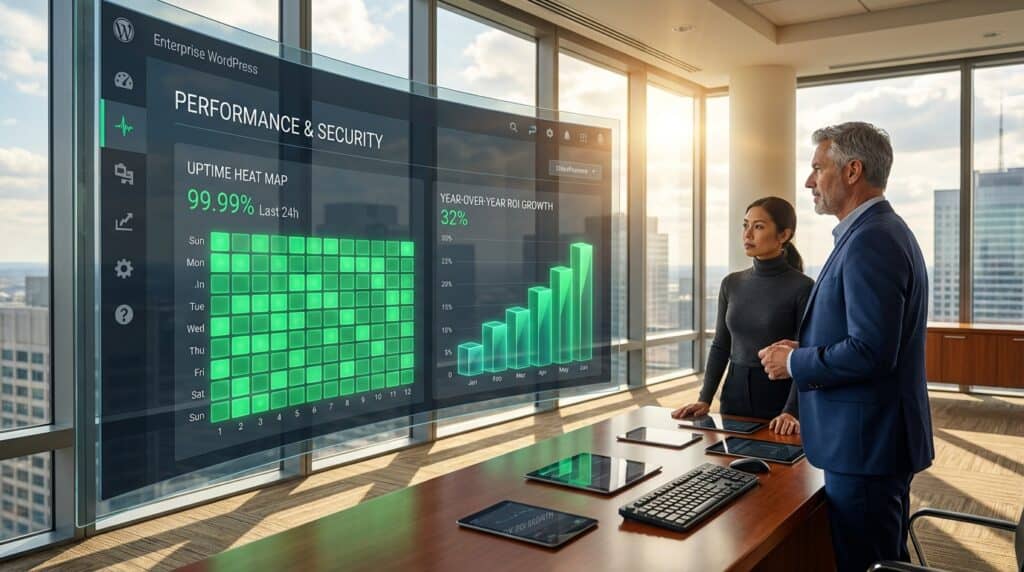
In 2025, enterprise WordPress maintenance has shifted from a line-item expense to a source of strategic value. Recent data shows that organizations moving beyond basic upkeep to managed enterprise solutions see a 415% return on investment over three years. With WordPress serving as a mission-critical asset for global brands, the focus is no longer just on basic functionality. It is about leveraging a platform that pays for itself five times over through enhanced performance and security.
Modern enterprises are discovering that proactive maintenance is the key to achieving a 44% lower total cost of ownership compared to proprietary alternatives. By prioritizing business agility and technical stability, leaders are transforming their digital presence into a high-yield engine for growth. This shift allows teams to pivot faster and scale without the friction of legacy systems. Maximizing this financial advantage requires a move away from reactive fixes toward a robust, enterprise-grade maintenance strategy.
Key Takeaways
- Enterprise WordPress maintenance delivers a 415% return on investment over three years by eliminating technical debt and shifting internal focus from upkeep to high-value innovation.
- Adopting a managed WordPress environment provides a 44% lower total cost of ownership compared to proprietary systems by removing expensive licensing fees and mandatory vendor upgrades.
- Proactive security and infrastructure management protect brand reputation and prevent the significant revenue losses associated with downtime and security breaches.
- Outsourcing technical maintenance to specialized partners increases business agility, allowing marketing and development teams to deploy updates and scale traffic without technical bottlenecks.
Financial Gains From Reduced Total Cost of Ownership
Transitioning from a proprietary CMS to a professionally managed WordPress environment offers a direct path to reducing the average 2.6 million dollar annual cost associated with enterprise digital infrastructure. While legacy systems often trap organizations in expensive licensing cycles and mandatory vendor upgrades, WordPress leverages an open source foundation that eliminates these recurring capital expenditures. By shifting these funds toward high efficiency managed workflows, decision makers can redirect capital from static maintenance fees into active growth initiatives. This strategic pivot reduces the Total Cost of Ownership by replacing bloated, multi-year contracts with predictable, performance-based service models.
The financial advantage becomes even clearer when evaluating the 44 percent lower total cost of Ownership that WordPress provides compared to its enterprise competitors. Professional maintenance teams streamline this further by automating security patches and performance tuning, which prevents the costly technical debt that typically plagues internal IT departments. Instead of diverting high-level engineers to troubleshoot plugin conflicts or server outages, enterprises utilize managed workflows to maintain mission-critical stability. This shift ensures that every dollar spent on the platform contributes to system resilience and speed rather than just basic upkeep.
Investing in specialized maintenance also unlocks a massive return on investment, often reaching as high as 415 percent over a three-year period. These gains are realized through increased developer productivity and the elimination of the specialized, high-cost labor required to maintain proprietary codebases. When professional management handles the underlying architecture, internal teams are free to focus on delivering customer value and accelerating time to market for new digital experiences. Ultimately, the move to managed WordPress maintenance transforms the website from a significant cost center into a lean, high-performing business asset.
Quantifying The 415 Percent Return On Investment

Justifying the cost of premium WordPress management requires looking beyond simple line items to the broader financial impact on the organization. A recent Forrester Total Economic Impact study reveals that enterprises utilizing high-level WordPress management can achieve a 415 percent return on investment over a three-year period. This return is driven by the elimination of costly emergency fixes and the reduction of technical debt that typically plagues internal teams. By offloading complex infrastructure tasks to specialized experts, organizations ensure their digital presence remains a revenue generator rather than a drain on resources. This strategic shift allows internal developers to focus on high-value innovation instead of routine maintenance and security patches.
Infrastructure stability and proactive security measures represent the backbone of this financial gain. Data indicates that enterprise-grade maintenance pays for itself five times over by preventing the financial losses associated with downtime and security breaches. When a mission-critical site goes down, the cost per minute in lost conversions and brand reputation often exceeds the annual price of a professional management contract. Modern maintenance providers use automated monitoring and rapid response protocols to maintain 99.9 percent uptime, which directly contributes to a 44 percent lower total cost of ownership. These efficiencies create a predictable budget model that replaces the volatile expenses of reactive, unmanaged environments.
Business agility serves as the final pillar in quantifying the value of professional WordPress oversight. Decision makers who invest in specialized management see a significant reduction in time to market for new digital initiatives and marketing campaigns. Because the underlying platform is consistently optimized for enhanced performance, teams can deploy updates and scale traffic without fearing a system collapse. This reliability transforms WordPress from a simple content tool into a robust, enterprise-ready engine for growth. Ultimately, the transition to managed services provides the peace of mind and financial clarity necessary for long-term digital scaling.
Strategic Business Agility and Market Speed Advantages
Offloading technical upkeep to specialized WordPress partners transforms a maintenance line item into a catalyst for rapid market expansion. When internal engineering teams are freed from the constant cycle of security patches and core updates, they can redirect their focus toward high-impact features that drive revenue. This shift in resources allows enterprises to move from a reactive posture to a proactive strategy, ensuring that digital products evolve at the speed of consumer demand. By leveraging professional management, organizations eliminate the technical debt that often slows down large-scale deployments. The resulting increase in operational velocity provides a measurable competitive edge.
Reliable infrastructure management directly correlates with the ability of marketing and content teams to pivot during critical business cycles. Specialized WordPress maintenance ensures that the platform remains stable and performant even during high-traffic events or rapid content rollouts. This stability empowers non-technical staff to launch campaigns and update messaging without waiting for IT bottlenecks to clear. With a reported 44 percent lower total cost of ownership compared to proprietary systems, the financial justification for professional management is clear. These savings represent reclaimed hours and resources that can be reinvested into brand innovation.
Strategic business agility is further solidified through the integration of advanced security and performance optimization provided by dedicated experts. Enterprises that utilize managed services often see a substantial return on investment, sometimes exceeding 400 percent over a three-year period. This level of efficiency is achieved by minimizing the risk of downtime and ensuring that the site is always optimized for search engines and user experience. When a platform is consistently tuned for peak performance, the path from content creation to conversion becomes much shorter. Ultimately, professional maintenance bridges the gap between technical reliability and the overarching financial goals of the enterprise.
Mitigating Enterprise Risk Through Proactive Security Management

Proactive security management serves as a critical insurance policy for the modern enterprise, transforming maintenance from a line-item expense into a strategic safeguard. When decision-makers weigh the WordPress cost of professional management against internal handling, they must account for the financial impact of a single security breach. Beyond the immediate technical remediation, a compromised site can lead to permanent brand erosion and loss of customer trust. Professional maintenance ensures that every layer of the WordPress ecosystem is hardened against evolving threats. This level of oversight prevents the revenue loss associated with downtime during peak traffic periods.
The financial justification for specialized maintenance becomes clear when examining the hidden costs of reactive troubleshooting. Relying on internal teams often leads to fragmented security protocols and delayed patch deployments, which increases the window of vulnerability. Professional managed services provide 24/7 threat monitoring and automated fail-safes that internal IT departments may struggle to maintain alongside their primary duties. By outsourcing these high-stakes responsibilities, enterprises can achieve a 44% lower total cost of ownership compared to traditional proprietary systems. This approach allows the organization to focus on growth while experts handle the complexities of digital risk.
Maintaining a secure enterprise environment directly supports long-term business agility and consistent market performance. Organizations that invest in consistent updates and rigorous security audits realize a 415% return on investment over a three-year period. This ROI is driven by the avoidance of regulatory fines, data recovery fees, and the high price of emergency developer intervention. Strategic maintenance ensures that WordPress remains a mission-critical asset rather than a liability. By prioritizing professional security management, leadership secures the bottom line and ensures the platform remains a reliable engine for global operations.
Maximizing Asset Value and Maintenance ROI
Ultimately, the decision to invest in professional enterprise WordPress maintenance is a transition from viewing web infrastructure as a cost center to recognizing it as a high-performance asset. With a potential 415% ROI and a significantly lower total cost of ownership compared to proprietary systems, the financial justification for expert management is clear. By offloading technical upkeep to specialists, organizations eliminate the hidden expenses of internal resource diversion and the risks of site downtime. This strategic shift allows internal teams to focus on innovation and market growth rather than patch management or troubleshooting.
Professional management serves as the primary driver of long-term platform value by ensuring that your digital presence remains secure, scalable, and performant. In an era where a single second of latency can erode conversion rates, the proactive optimization provided by dedicated experts is indispensable for maintaining a competitive edge. These services provide the necessary bridge between technical stability and enterprise scalability, allowing enterprises to respond to market shifts with confidence. Maintaining a mission-critical platform requires more than just reactive fixes. It demands a holistic approach to digital health.
As your organization looks to maximize its digital potential, securing the right infrastructure and support is the most critical step toward sustainable growth. High-performance hosting and expert oversight go hand in hand to protect your investment and ensure your WordPress website’s success alongside your business objectives. To discover how our WordPress and Hosting solutions can help you achieve these enterprise goals, explore our comprehensive service offerings today. Investing in professional management ensures your WordPress ecosystem remains a powerful engine for your brand’s ongoing success.
Frequently Asked Questions
1. What kind of ROI can my organization expect from enterprise WordPress maintenance?
2. How does WordPress lower the total cost of ownership compared to proprietary systems?
3. Why is proactive maintenance better than a reactive approach?
4. Can WordPress maintenance help reduce annual infrastructure costs?
5. How does enterprise maintenance impact business agility?
6. What is the financial benefit of switching from a proprietary CMS?