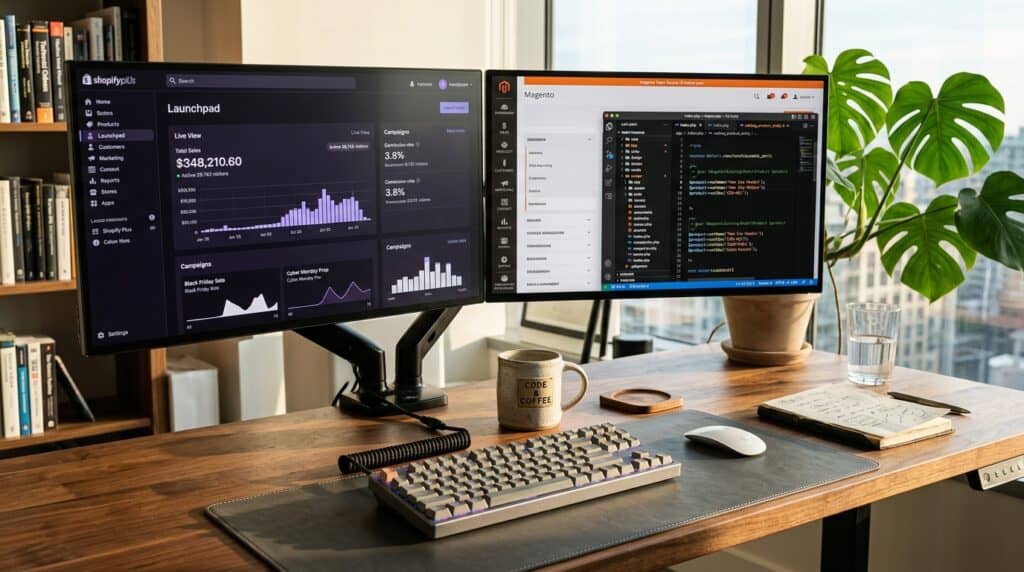
In 2026, choosing between Shopify Plus and Adobe Commerce has shifted from a simple feature comparison to a fundamental decision about your business model. High-growth brands now face a critical crossroads: prioritizing the rapid speed-to-market of a fully managed ecosystem or the granular architectural control of a self-hosted framework. Your choice will dictate not only your operational overhead but also your team’s ability to pivot in an increasingly competitive digital economy.
Success depends on finding the perfect balance between efficiency and the freedom to build bespoke customer experiences. While one platform offers a streamlined, automated approach that eliminates the burden of manual maintenance, the other provides an open-source foundation for complex, multi-layered B2B workflows. Understanding how these distinct infrastructures align with your long-term scaling strategy is the key to securing a dominant market position.
Key Takeaways
- The choice between Shopify Plus and Adobe Commerce is a strategic trade-off between operational agility and architectural sovereignty.
- Shopify Plus offers a significantly lower total cost of ownership and faster time-to-market by automating infrastructure, security, and maintenance.
- Adobe Commerce remains the preferred solution for enterprises requiring total codebase control to manage complex, multi-layered B2B workflows and proprietary backend logic.
- High-growth brands must prioritize platforms that align with their internal technical maturity and the ability to pivot quickly in a competitive digital economy.
Comparing Total Cost Of Ownership And Infrastructure
When evaluating the total cost of ownership, the most significant distinction lies in how each platform handles infrastructure and ongoing maintenance. Shopify Plus operates on a fully managed SaaS model where hosting, security, and global auto-scaling are bundled into a predictable monthly fee. This eliminates the need for internal teams to manage server uptimes or emergency patches, allowing enterprise leaders to reallocate technical budgets toward growth and customer experience. In contrast, Adobe Commerce often requires a dedicated DevOps team or a specialized agency to manage complex hosting environments and manual version upgrades. These recurring technical overheads can create unpredictable spikes in expenditure that often exceed the initial licensing costs.
The financial trade-off between these two ecosystems centers on the balance between operational efficiency and architectural autonomy. Shopify Plus utilizes a revenue-based fee structure that scales with your business, providing a transparent cost model that includes constant platform innovations without additional integration debt. Adobe Commerce offers a more traditional licensing approach that grants full access to the core codebase, but this flexibility comes with the heavy price of mandatory security updates and performance tuning. For high-revenue brands, the decision often comes down to whether they prefer the lean, agile nature of a managed service or the high-touch, resource-heavy requirements of a self-hosted environment.
Beyond the baseline fees, the time to market and development velocity play a crucial role in the overall return on investment. Shopify Plus allows enterprise merchants to launch complex builds in nearly half the time required for a standard Adobe Commerce implementation, significantly reducing the cost of delayed entry into new markets. Because the SaaS model handles the foundational infrastructure, developers can focus exclusively on front-end differentiation and custom logic via modern APIs. While the Adobe ecosystem provides deep customization for intricate B2B workflows, the cumulative cost of maintaining that custom code over several years often results in a much higher total cost of ownership compared to the streamlined Shopify model.
Architectural Flexibility Versus Speed To Market

Choosing between Shopify Plus and Adobe Commerce requires a strategic evaluation of whether your business prioritizes rapid deployment or total structural autonomy. Shopify Plus is engineered for enterprise brands that need to launch quickly and iterate in real time without the burden of managing underlying infrastructure. By utilizing a managed SaaS environment, stakeholders can focus on market expansion and customer experience rather than server maintenance or security patches. This approach significantly reduces the time to market, often allowing high revenue businesses to go live in nearly half the time required for a traditional build.
Adobe Commerce offers a fundamentally different value proposition by providing developers with complete access to the core codebase for unlimited architectural flexibility. This platform is the preferred choice for organizations with highly specialized technical requirements, such as unique logic for global supply chains or complex, multi-layered B2B workflows. While this level of control necessitates a longer development lifecycle and a dedicated technical team, it ensures that the software can be molded to fit the exact operational needs of the business. The decision rests on whether your competitive advantage stems from proprietary backend logic or the ability to respond to consumer trends with agility.
Modern commerce leaders must weigh the long-term costs of technical debt against the immediate benefits of a streamlined ecosystem. Shopify Plus has significantly closed the customization gap through recent advancements in its API capabilities and extensible functions, making it a viable contender for many complex builds. However, for those enterprise entities that view their e-commerce platform as a bespoke piece of intellectual property, the open nature of Adobe Commerce remains an essential requirement. Ultimately, the right choice aligns your enterprise architecture with your internal resource capacity and your specific roadmap for digital transformation.
Native B2B Functionality And Enterprise Scaling
The enterprise commerce sector has shifted as Shopify Plus has expanded its native B2B suite to compete directly with traditional heavyweights. High-revenue brands can now manage wholesale and direct-to-consumer operations from a single dashboard, utilizing built-in features like company profiles, price lists, and net payment terms. This integration eliminates the need for expensive third-party apps that previously bloated site performance and complicated the user experience. For many scaling businesses, this shift represents a move toward operational efficiency, allowing teams to focus on growth rather than managing technical debt. The platform now supports complex purchasing rules and volume-based pricing that were once only available through custom-coded solutions.
While Shopify Plus excels in speed and agility, Adobe Commerce continues to set the standard for organizations requiring intricate multi-store global workflows. Large enterprises with highly specific procurement processes or complex organizational hierarchies often find the platform’s granular control over the codebase indispensable. It allows for deeply nested account structures and custom approval workflows that cater to the most demanding industrial or international distribution models. For businesses operating across dozens of regions with unique tax laws and localized catalogs, the architectural flexibility provides a level of precision that a standardized SaaS model cannot always match. This makes it a preferred choice for companies that view their digital infrastructure as a completely proprietary asset.
Scaling an enterprise brand requires a strategic choice between the simplified maintenance of a managed cloud environment and the total autonomy of a platform-as-a-service model. Shopify Plus offers a lower total cost of ownership by automating security patches and hosting infrastructure, which is highly attractive to brands looking to launch new markets in weeks rather than months. Conversely, Adobe Commerce attracts those who need to integrate with legacy ERP systems through highly customized middleware or unique on-premise configurations. Ultimately, the decision hinges on whether a business prioritizes the rapid deployment of native features or the ability to build a bespoke commerce engine from the ground up. Both platforms have matured significantly, ensuring that enterprise leads have robust options regardless of their specific technical requirements.
Choosing the Right Enterprise Commerce Path
Ultimately, the choice between Shopify Plus and Adobe Commerce hinges on whether your organization prioritizes operational agility or total architectural sovereignty. High-revenue brands that value a rapid time to market and a lower total cost of ownership often find Shopify Plus to be the superior choice for scaling without the burden of manual server maintenance. Conversely, enterprise businesses with deeply entrenched B2B workflows or highly specific data structures may require the unrestricted codebase access that Adobe Commerce provides. Deciding between these platforms is less about comparing feature lists and more about auditing your internal technical maturity and long-term infrastructure goals.
Navigating a platform shift requires a calculated approach to moving sensitive customer data, product catalogs, and order histories without disrupting your current revenue streams. For brands ready to move away from technical debt and embrace a more modern ecosystem, the transition must be handled with extreme precision to avoid the costly ecommerce replatforming mistakes that kill growth. Our professional Content Migration Service Pricing Guide For Secure Data Replatforming offers a transparent look at how we facilitate these complex transitions for enterprise-level clients. We can help you streamline your migration process and position your business for sustained growth on the platform that best fits your operational needs.
Frequently Asked Questions
1. How do the infrastructure costs differ between Shopify Plus and Adobe Commerce?
Shopify Plus utilizes a fully managed SaaS model where hosting and security are included in a predictable monthly fee. Adobe Commerce requires you to manage your own hosting environments and pay for a dedicated DevOps team to handle manual version upgrades and server maintenance.
2. Which platform offers a faster speed to market for high growth brands?
Shopify Plus is designed for rapid deployment through its streamlined, automated ecosystem that eliminates the burden of manual maintenance. This allows your team to prioritize immediate growth and customer experience over technical infrastructure setup.
3. Is Adobe Commerce better for complex B2B business models?
Adobe Commerce provides an open source foundation that is better suited for businesses requiring granular architectural control and multi layered B2B workflows. You gain the freedom to build bespoke customer experiences and complex backend integrations that a standard SaaS model might restrict.
4. How does platform choice impact your technical team’s workload?
Choosing Shopify Plus allows you to reallocate your technical budget toward innovation because the platform handles global auto scaling and security patches automatically. Adobe Commerce demands constant internal oversight to manage emergency patches and complex hosting environments, which increases your operational overhead.
5. Which platform provides better long term scaling stability?
Shopify Plus offers superior stability through its managed infrastructure that scales automatically during traffic spikes without manual intervention. Adobe Commerce offers scaling flexibility through its self hosted framework, but it requires your team to proactively manage server capacity and architectural performance.
6. What is the primary trade off when choosing between these two ecosystems?
The decision centers on the balance between operational efficiency and architectural autonomy. You must choose between a streamlined, automated approach that protects your speed to market or a highly customizable framework that gives you total control over your digital infrastructure.